Facing the future with scenario work
Use this model if…
- …your newsroom is about to make a bet on AI, platforms or products, and you want to test it against more than one future.
- …the strategy debate keeps getting stuck on predicting what will happen, and you want to plan for what you would do in each case.
- …you want editorial, product and the business side to share one picture of what is uncertain, and to agree on the signs that would tell you which future is arriving.
Origin: Scenario work began in Cold War defense planning. In the late 1940s Herman Kahn, a young analyst at the RAND Corporation, told short stories about how nuclear weapons might be used, and the screenwriter Leo Rosten suggested calling them scenarios. Royal Dutch Shell brought the method into business. Its planners started long-range studies in the mid-1960s, and in the early 1970s Pierre Wack and Ted Newland used scenarios to warn Shell's leadership that the oil market was about to change. When the 1973 oil crisis hit, Shell was better placed than its rivals. For Wack, the aim was never to predict. Scenarios were there to change the picture of the world that managers decide from, and the work started by separating what was already settled, the predetermined elements, from what was uncertain. Peter Schwartz, who had worked in Shell's planning team, later co-founded Global Business Network with Napier Collyns and set the method out in his book The Art of the Long View.1
What does the model really do? It crosses two critical uncertainties to make four worlds, then asks what you would do in each. The 2×2 is not the only way to do scenario work, and not always the best. What it has going for it is that a newsroom can run it without a futurist in the room. Two uncertainties and four worlds fit on one whiteboard, and everyone can see where they stand. That is why it is one of the best known and simplest scenario methods, and why it is the one on this page.
Newsrooms have done this
- The Dutch Journalism Fund (2015) crossed two uncertainties to map four futures for 2025, and gave newsrooms a free toolkit to run it.
- The Open Society Foundations (2024) built five scenarios for an AI-run information ecosystem, using affinity mapping rather than a 2×2.
- The 19th (2025) mapped more than a dozen risks and what it would do about each.
- NRK ran a scenario process before setting its strategy.
The six steps
Run the steps with people from editorial, product and the business side, since each of them sees different uncertainties. Do not expect to finish in one workshop. Napier Collyns, who co-founded Global Business Network, warned that the method got watered down into short workshops after which people went back to business as usual. The 19th made scenario planning a regular practice rather than a one-time exercise.
1. Gather the questions that matter. Agree first on how far ahead you are looking. Then collect the questions your team cannot yet answer about that period. Write each one down as a question, not as a trend. A question invites more than one answer, while a trend assumes one.
2. Sort them by impact and uncertainty. Ask two things of each question. How much would the answer change your newsroom, and how sure are you of the answer? Questions with high impact and a fairly certain answer are predetermined elements. They belong in every world, so you can stop arguing about them. Questions with high impact and an uncertain answer are your critical uncertainties. Questions that are yours to decide are choices. Set them aside for step 5, because a choice is something you test in each world, not something that defines one.
3. Cross the two most important uncertainties. Pick the two critical uncertainties that matter most and are independent of each other. Each becomes an axis, and the four corners become four worlds. Keep your own choices off the axes, because a world you can choose your way into tells you nothing about the one you cannot. Check the pair by reading all four corners. If one corner barely holds, or if moving along one axis drags the other with it, the axes are not independent and the grid collapses into a single line. Pierre Wack warned against exactly that, scenarios that vary along only one dimension.
4. Write a short story for each world. Give each world a name and a few paragraphs that describe it as if it had already arrived. Say how people get their news there, whom they trust and who makes money. Add one sign of it you can already see today. The stories should feel equally plausible. If one reads like the official forecast and the others like warnings, rewrite them.
5. Trace what each world does to your newsroom. This is the step that turns four stories into a plan. Use a fixed checklist of the areas your strategy covers, the same in every world, and ask what each area looks like inside each world. The result is a table with one column per world. Where the answer is different in every world, your current strategy is most at risk. Test the choices you set aside in step 2 here too, by asking how each one fares in each world.
6. Find the no-regret moves and the signposts. A no-regret move pays off in all four worlds, so you can start it now. A signpost is an early sign that one world is arriving, chosen in advance so you notice it when it comes. For each signpost, agree what you will do when you see it.
I think that's going to be the critical thing in the future. How can you keep all the burners on, even in a lightweight way, and then turn the dials up a little when you see things really take off?
Anna Dubenko, The New York Times
Come back to the map whenever a signpost moves.
Worked example
Below, I run the six steps on the question this site is built around, which is how audience engagement changes in the AI era.
1. The questions
I set the horizon at three years, to 2029, because AI products change so fast. The questions came from the four elements of this site's framework. Their pages hold close to twenty questions about the AI era, from who we serve when AI can build a news service around one person to who checks the definitions when AI acts on them.
2. The sorting
Three questions turned out to have fairly certain answers, so they hold in every world.
- AI answers more of the questions people used to bring to the web, and sends fewer visits.
- AI makes it cheap to build a news service around one person.
- Models and agents take over routine work on audience data.
Four stayed truly uncertain.
- Will people want a shared picture of the news, or news tailored to them?
- Does a direct relationship with a news brand keep its value, or is an answer enough?
- Does the article survive, or does journalism go liquid?
- How much of what readers need can AI give them?
The rest were choices, such as Engagement's practice question, whether to build the relationship inside a product you own or make your journalism legible inside interfaces you never will. Others were whether the depth of the relationship should set the price, and who owns verification and trust.
The sorting showed a pattern. The uncertainties sat almost entirely in Audience and Engagement, the elements that face outward. Measuring success and Audience development, which face inward, held only choices. So the worlds come from the first two, and the last two are where a newsroom prepares.
3. The axes
I crossed the first two uncertainties. One axis runs from a shared picture of news to news tailored for me, the other from a relationship with news brands that holds to an answer from an AI that is enough. I also tested the other two as a pair, the article surviving against journalism going liquid, crossed with how much of what readers need AI can give. That grid failed the check. If AI gives readers most of what they need, the article tends to dissolve, so the axes moved together, and one corner, where the article survives as a relic, barely held.
4. The worlds
Four worlds for news in the AI era
Two open questions decide how people get their news by 2029. Crossing them gives four possible worlds.
| Shared picture of news | Tailored news for me | |
|---|---|---|
| Relationship with news brands holds | The shared voice. Everyone gets the same picture of the day, from news brands they know. The Atlantic's editors still choose almost everything readers see, and it has 1.6 million paying subscribers. | The personal voice. Each person gets news built around them, from a news brand they trust. The Washington Post makes each reader a personal AI podcast from the stories they read. |
| Answer from an AI is enough | The common answer. Everyone gets the same answer from AI search or an aggregator, and few ask who reported it. Google's AI Overviews has more than 2.5 billion monthly users, and clicks to websites drop by nearly 60% when one appears. Particle sums up the same big stories for everyone. | The private feed. Each person's AI assistant assembles their news, and newsrooms supply the material. Lisa AI turns dozens of Argentine news sites into a personal ten-minute newscast. |
The shared voice. In 2029 most people still start the day with a news brand they know. AI search answers their quick questions, but for what matters today they open a front page or an app that editors have put together, and they read or listen to the same stories as their neighbours. AI has become a natural part of the newsroom workflow for creating versions, so they can choose a listen on the bike or a read on the bus from the same article, with exactly the same script. The picture of the day remains shared. Trust stays with the brands that show their work. The money still comes mostly from readers, who pay because they want to be part of the same conversation, and from advertisers who want to reach them there.
The personal voice. In 2029 people still choose a news brand, but each of them gets a different version of it. The brand's own AI knows what they read and how much time they have, and builds their news around that, a morning briefing on the way to work or a few longer stories in the evening. The journalism still comes from the newsroom, and the brand's voice holds it together, so readers trust the masthead more than any single story. That trust is also the risk. When the AI gets a quote or a fact wrong, the brand carries the mistake. The money comes from readers who pay for a service that knows them, and the price may follow how deep the relationship goes.
The common answer. In 2029 most people get their news by asking an AI, or from one of the few popular aggregators that sum up the big stories, such as Particle. Both give everyone roughly the same answer, so a shared picture of the day survives, but the platform is the one putting it together. Few people ask who reported it, and even fewer click through to find out. News brands still do the reporting, yet to most readers they are a name in a list of sources, if they are named at all. Trust goes to the answer. The money goes to the platform, and newsrooms earn what they can from licensing deals with the few AI companies that pay for journalism.
The private feed. In 2029 each person's AI assistant knows them well enough to put together their news without being asked. Overnight it reads dozens of outlets, and in the morning it delivers a briefing in the length and language its owner prefers, next to their calendar and their messages. No two people get the same picture of the day, and few could say where a story came from. Trust belongs to the assistant. The money goes to the companies that make the assistants, and newsrooms are paid per use, if at all, by the ones that choose to license journalism. A newsroom's job becomes supplying material that a machine can read and cite.
Where brands stand today
The four worlds are futures, but today's brands already lean toward one or another. Below, I have placed brands mentioned on this page on the grid, using public data where it exists and judgement where it does not. Every position is an estimate. Treat it as an example: any newsroom can draw its own version and place itself and its competitors on it.
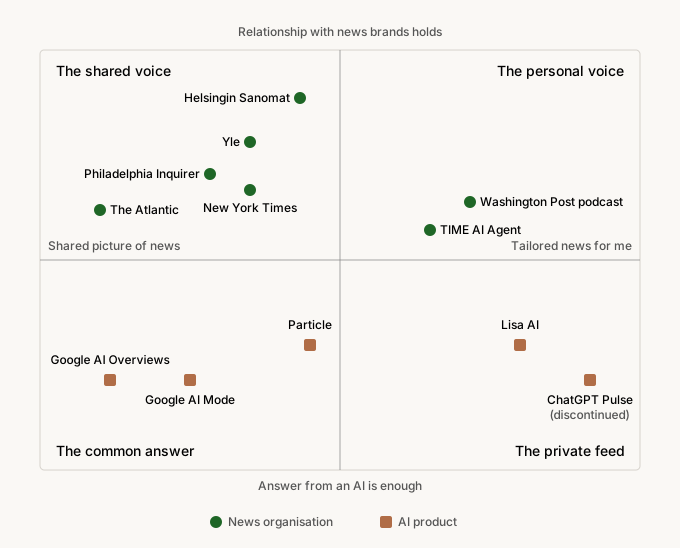
Brands on the four worlds, October 2026. In the top row, height follows each site's share of direct desktop visits on Similarweb: Helsingin Sanomat, Yle, New York Times, Philadelphia Inquirer, Washington Post, The Atlantic and TIME. Left to right follows how much each brand personalises. Positions in the bottom row are my judgement.
In the top row, height shows how much of each news site's traffic comes straight to the brand rather than through search or social media. That is the closest public measure of a relationship that holds. The figures are Similarweb's estimates of direct desktop visits for September 2026, or July for the Inquirer. They leave out apps, so they understate brands whose most loyal readers use the app. Zetland is left off for that reason, since its members mostly listen in the app. Other tools define direct visits differently, so these figures compare only with each other. The TIME and Washington Post dots carry the names of their AI products, but their height comes from traffic to the whole site.
The bottom row has no comparable number, because AI products are not measured by how many readers they send on to news brands. The one measured figure points down. When a Google AI Overview appears, clicks to websites drop by nearly 60%. Particle and Lisa AI sit a little higher on my best guess, because both are built on summarising news outlets' stories, and Lisa links to the stories it cites.
Left to right shows how much each brand personalises, as far as public sources and my interviews tell. The Atlantic's editors curate almost everything readers see. About 40% of the Philadelphia Inquirer's homepage is automated. Yle lays out half of its news front page by hand and does not plan large-scale personalisation, and at the New York Times nearly half of the homepage is programmed with help from algorithms. Helsingin Sanomat's height comes from Similarweb like the others, and its place from left to right rests on my own knowledge of it (I work there). TIME's AI agent answers each reader's own questions, in their format and language. The Washington Post builds a personal podcast from what each reader reads, on top of a personalised section on its homepage.
Among the AI products, nothing I found says Google's AI Overviews personalises. AI Mode can draw on Gmail and Photos, but only as an opt-in experiment for paying subscribers in the US. Particle calls itself personalised news but shows everyone the same big stories on its website. Lisa AI builds each listener's newscast from topics they choose. ChatGPT Pulse drew on memory, chat history and connected apps. It has since been discontinued, but similar services can be expected to appear in the near future.
The grid shows a line nobody has crossed yet. Every news brand sits in the top row and every AI product in the bottom one. No news brand has shown it can own the common answer or the private feed, and no AI product has won the kind of relationship a news brand has. In the bottom row, newsrooms appear only as suppliers.
Any newsroom can draw this for itself. Your own analytics give your share of direct-relationship traffic, app included, the measure Condé Nast tracks in its end-to-end KPIs. Similarweb gives a rough figure for competitors' websites. Your team knows how much you personalise, and competitors' announcements and interviews tell you about theirs. The positions will be arguable. That helps, because a disagreement about where you stand today starts the conversation about which world you are preparing for.
5. What each world does to the newsroom
I answered the questions of each element again inside each world. The four tables below give the short version, one element at a time, with the element's questions for the AI era above each table.
- Purpose: Who do we serve, and why, when AI can build a news service around a single person?
- Substance: What do they need that AI cannot give them, and can we serve that?
- Practice: How do we keep learning from real people, when a synthetic panel answers in seconds?
| World | Answer |
|---|---|
| The shared voice | A broad public, a region or a country, coming for the shared picture of the day. Direct visits keep the newsroom close to real readers. |
| The personal voice | Individual readers, one relationship at a time. The newsroom knows each of them through its own data, and has to keep checking that data against real people. |
| The common answer | People the newsroom never sees. They meet its reporting inside someone else's answer, so it learns about them only from what the platform chooses to share. |
| The private feed | The assistants that read the journalism come first, and the people behind them are out of sight. What those people still need from journalists is what AI cannot give, such as local knowledge. |
- Purpose: As platforms disconnect the content from who made it, the organic top of the funnel dries up. Does that change the definition of purposeful engagement?
- Bond: When the article as we know it is challenged, what is left for people to attach to? A brand, a reporter, a habit, a format?
- Practice: Do you build the relationship inside a product you own, or make your journalism legible inside interfaces you never will?
| World | Answer |
|---|---|
| The shared voice | People attach to the brand and the daily habit. The relationship lives in products the newsroom owns, and being a destination pays off. |
| The personal voice | People attach to the brand's voice and to a product made for them. The newsroom is still a destination, but the experience is different for every reader. |
| The common answer | People attach to the answer machine or aggregator. Engagement happens on the platform, and the newsroom's best hope is to be named often enough that some readers come looking. |
| The private feed | People attach to their assistant. The newsroom is a supplier, and a reporter with a following of their own may be the last bond that reaches a person directly. |
- Purpose: What decision does this number serve, now that a model may be doing the deciding?
- Substance: Should the depth of the relationship set the price a reader pays?
- Practice: Who checks that the definitions are still right, when AI acts on them without anyone reviewing each decision?
| World | Answer |
|---|---|
| The shared voice | Habit, retention and direct visits count most, much as they do now. Privacy rules and devices hide a growing share of readers, so even the newsroom's own numbers get harder to read. |
| The personal voice | The depth of each relationship counts, and it can set the price each reader pays. That depends on seeing each reader, which privacy rules and devices make harder, and a price set by a model nobody checks can feel unfair. |
| The common answer | Citations and licensing income count, because visits are rare. The newsroom measures how often it is named in answers, using data the platform controls. |
| The private feed | Use by machines counts: how often assistants choose and cite the material, and what they pay for it. Crawls become the unit, and the reader behind them is out of sight. |
- Purpose: Why are we doing audience development, when agents can read the data and draft the distribution?
- Substance: What does the craft cover, when discovery, product and data run through the same agents?
- Practice: How is the verification done and the trust kept, when anyone in the newsroom can ask the data a question?
| World | Answer |
|---|---|
| The shared voice | The craft moves into the newsroom's daily choices, the front page, the newsletters and the habits around them. Agents take over the routine data work, and people keep the editorial judgement. |
| The personal voice | The craft becomes product work, designing the AI that builds each reader's news and checking what it says in the brand's name. Verification becomes a daily job, because every mistake carries the masthead. |
| The common answer | The craft turns outward to the machines. Discovery has to be learned again, so the work is about being found and credited in answers, and about what the platforms pay. |
| The private feed | The craft becomes supply work, making the journalism legible to assistants and proving where it came from, so a machine can tell it from the noise. |
Learning from real people gets harder the further a world sits from the shared voice. The choice between being a destination and a supplier follows the vertical axis alone, so it cannot wait for the future to settle. The unit of measurement moves from the reader toward the machine. Verification and trust are needed in every world, though each world asks something different of them. Each world also keeps a different answer to what people attach to. The shared voice keeps the brand and the habit, and the personal voice keeps a product made for each reader. The common answer keeps only the machine itself, and the private feed perhaps a reporter with a following.
6. No-regret moves and signposts
Three moves pay off in all four worlds, so a newsroom can start them now.
- Make every story provable. Verification and a record of where the journalism came from serve every world. In the top row they earn trust and protect the masthead when the brand's own AI makes a mistake. In the bottom row they make the material worth citing and paying for.
- Write once, publish in any form. A workflow where one checked script becomes any version, from a listen on the bike to a personal briefing, serves the newsroom's own readers. The same structure makes the journalism legible to machines. It keeps both bets alive, the own product and the legibility to machines.
- Keep a direct line to real people. Newsletters and events where readers talk back keep the newsroom learning in every world. They matter most in the worlds where readers are out of sight.
The signposts are chosen in advance. Each points toward one world, and each comes with what to do when it moves.
| Signpost | Points toward | What to do |
|---|---|---|
| AI products credit and link to the journalism they use, as Lisa AI already does | A bottom row news brands can live in | Put more work into being found and cited |
| Your own share of direct traffic, apps included, falls two years in a row | Away from the top row | Shift weight from the destination to supplier work |
| Paying for journalism becomes standard practice among AI companies, beyond deals like The Atlantic's micropayments | Supplier work becomes a business | Price and license the material on purpose |
| Interest in AI-personalised news, still low today, rises past half of readers | Right, toward tailored news | Build personal versions on top of the shared picture |
| Daily AI briefings like the discontinued ChatGPT Pulse return and reach every user, not only paying ones | The private feed | Prepare the material for assistants, and decide what they may use |
I will come back to this page when one of them moves.
Footnotes
-
Peter Schwartz, The Art of the Long View (New York: Doubleday/Currency, 1991). ↩