Engagement – What is our purpose?
Updated 31 Aug 2026
Engagement = the relationship a publisher builds with its audience
- AI is the newest platform you do not own. Decide whether you are a destination or a supplier.
- Shift from reach to relationships. Habit-building matters more than raw traffic.
- Engagement boosts retention and loyalty. Engaged users are more likely to subscribe and return.
- Not all clicks matter. Focus on meaningful actions.
We have run the numbers: when a new subscriber reaches our engaged cohort, about four to eight visits in 30 days, their likelihood of renewing a year later rises dramatically. Engagement literally pays off.
— Mariah Craddick, The Atlantic
Defining Engagement
Engagement is the relationship a publisher builds with its audience. People can interact with a brand in countless ways, but it becomes engagement the moment their attention turns into a deliberate, value-creating action.
Engagement refers to any audience interaction that can be monetised. For example, page views on site, email subscriptions, or direct conversions.
Ross Maghielse, The Philadelphia Inquirer
Just as a publisher must define its audience, it must also define what engagement means. Outlets frame the concept differently, but three questions set the baseline.
- Purpose: Why is there engagement between us and the audience?
- Bond: What is it in us, and in what we make, that the audience engages with?
- Practice: How is that engagement built and sustained?
We define engagement as interacting with our journalism, developing a routine around it, or actively contributing to it.
Alexandra Smith, The 19th
The Arc of Engagement
Changes in engagement did not happen in isolation. They are the result of changing behaviors, technological evolution, the rise of digital platforms and the transformation of business models that followed.
In the pre-digital era (through 1994), journalism was predominantly a one-way conversation from news producers to the public. News outlets typically lacked the means to explicitly pursue audience engagement as we understand it today. As author Philip Schlesinger stated in 1978 (quoted by Columbia Journalism Review): "Total audience remains an abstraction, made real on occasion by letters or telephone calls, encounters of a random kind in public places, or perhaps more structured ones such as conversations with liftmen, barmen, and taxi-drivers."1
From awareness to action – Life in a funnel
While much of the attention economy is in turmoil, the foundational concept of a funnel seems to remain relevant to this day. The first audience journey framework in marketing originated with Elias St. Elmo Lewis's AIDA model (Attention, Interest, Desire, Action) in 1898, outlining the stages a consumer experiences on the path to purchase. Although AIDA was originally a list of steps in persuading someone to buy, it was later visualized as a funnel, illustrating how many potential customers enter at the top but only a few advance to take action at the bottom.
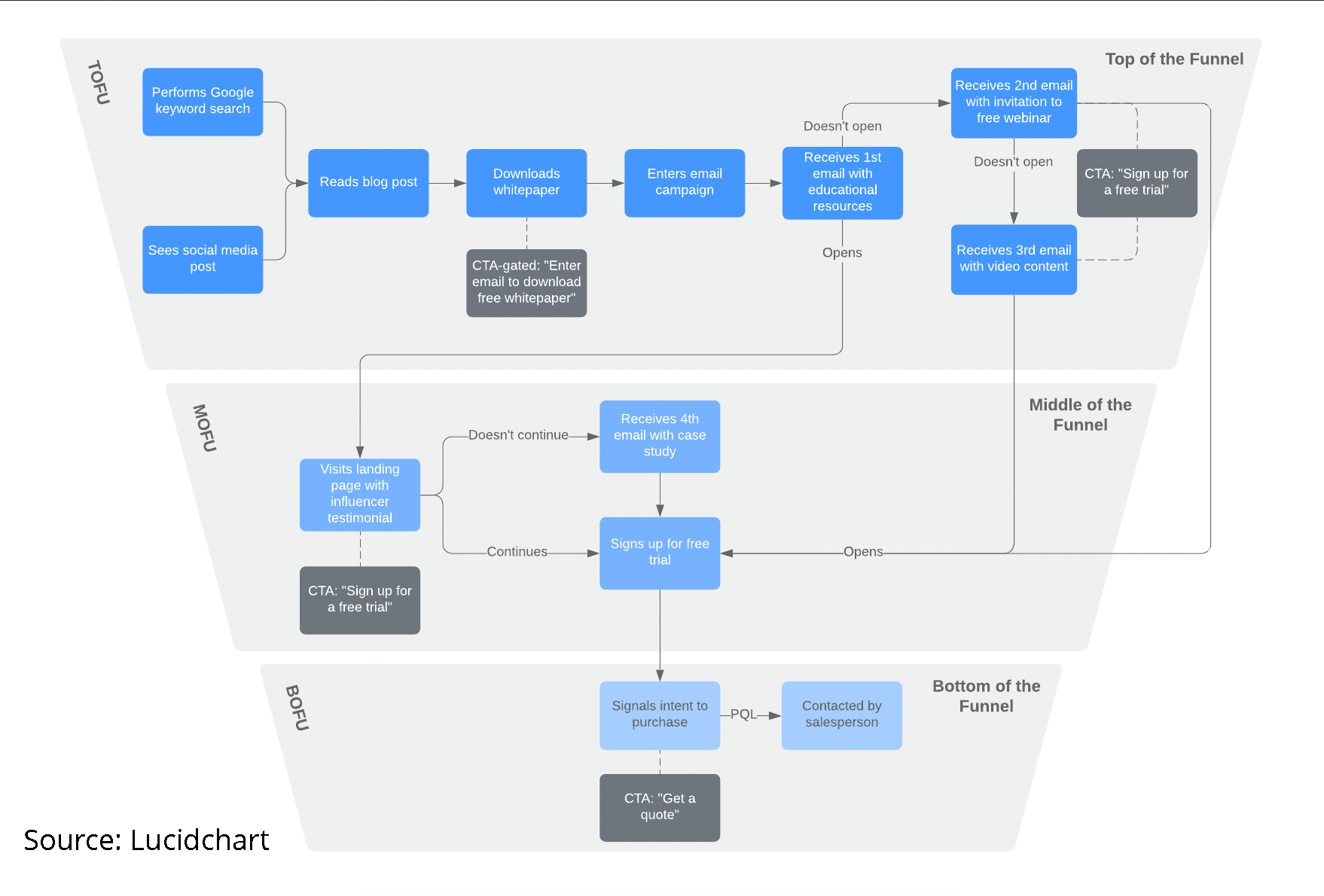
One effective way to connect the funnel concept with content strategy is to map a content chart directly onto the funnel. Source: Lucidchart
The early web era (1995–2005) brought the first experiments in two-way relationships and measurable engagement between journalists and their audiences. As websites emerged, basic web analytics tools, such as hit counters, and later, Google Analytics (launched in 2005), enabled publishers for the first time to track how many users visited their sites, identify the most popular pages, and understand how visitors discovered their content. As journalism's business model started shifting from print to digital, these analytics and targeting capabilities became essential The audience also acquired a voice on the page. From the late 1990s news sites began adding comment functions beneath articles, the first direct reply channel that did not pass through an editor.
The platform era (2006–2018) kicked off the competition in algorithm-based distribution. Ranking well in search became a newsroom skill, and the ranking could move without warning. When Google launched the Panda algorithm in February 2011 to downgrade shallow and low-quality pages, it affected around one in eight search queries and reordered which publishers were visible.
Then came social media. By mid-2015 Facebook had passed Google as the largest source of referral traffic to Parse.ly's network of around four hundred publishers, though Google's share held steady. Social was not replacing search, it was a second dependency stacked on the first. The platforms then raised the price of reach. By mid-2016 publishers' Facebook Pages had lost more than half their organic reach, and Facebook's June 2016 News Feed change made what remained depend on followers resharing posts rather than simply seeing them. Publishers now had to earn reach with engagement that happened on someone else's platform.
BuzzFeed, Huffington Post and USA Today are not succeeding simply because of lists, quizzes, celebrity photos and sports coverage. They are succeeding because of their sophisticated social, search and community-building tools and strategies, and often in spite of their content.
During the platform era's peak, Emily Bell and Taylor Owen found publishers pushing more of their journalism onto third-party platforms with no guarantee of return, to the point where "publishing is no longer the core activity of certain news organizations."2
After the conversion
In 2006, Xavier Blanc developed the REAN model (Reach, Engage, Activate, Nurture) to address the complexities of digital marketing and the entire customer lifecycle, including what happens after a purchase. The model was later popularized by Steve Jackson in his book Cult of Analytics. REAN is particularly well-suited for subscription-based businesses, where nurturing long-term relationships is critical to success. For a practical approach, you can read more about the model and create your own audience journey with this REAN template created by Miro.
We work within the REAN framework and view everything through that lens. First, in the Reach phase, we ask: How can we best find new customers? Then, in Engage, we focus on actions that bind those customers to the brand by turning them into repeat visitors and deepening their relationship with our products. The Activate phase is, of course, a major priority, but equally important is the Nurture phase, where we look after existing subscribers, keep them satisfied, and encourage them to buy again.
Sami Hannukka, Keskisuomalainen
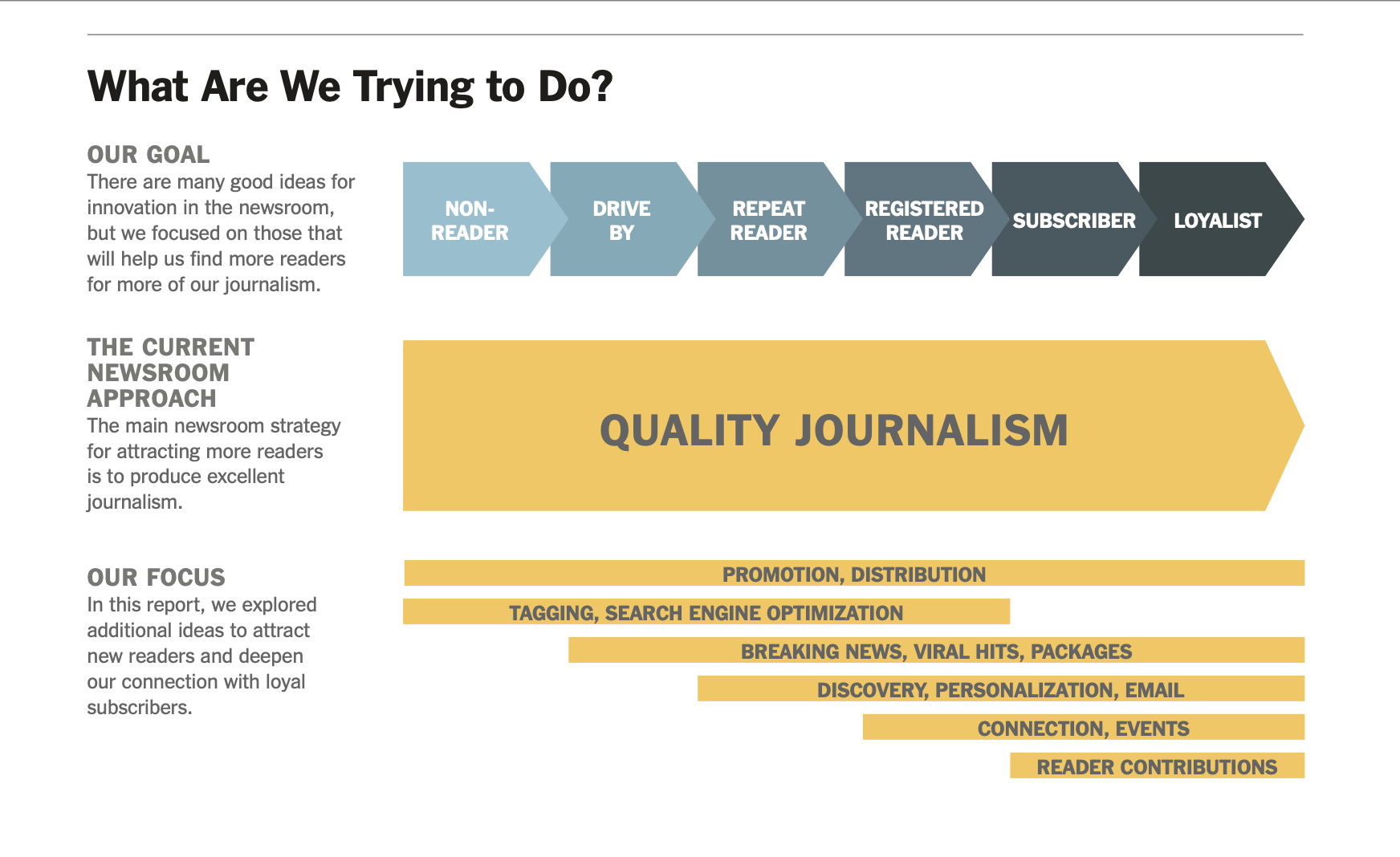
One of the earliest major adopters of audience journey thinking was The New York Times, which set out a structured model for deepening reader relationships in its 2014 Innovation Report. Labels vary between newsrooms, but the principle holds: attract a broad audience at the top, then guide it toward deeper engagement and loyalty.
The post-platform era (2018–2023) opened with a change that did not surprise the field. Facebook's January 2018 decision to put friends and family ahead of public content went further than its 2016 move in the same direction and publisher referrals fell sharply. When Nieman Lab asked around that same month, several had spent the previous year diversifying their channel strategies.
In 2018, Google renamed its mobile feed Discover, reporting 800 million monthly users and calling it a growing source of traffic for publishers. Google described the shift as moving from search queries to queryless discovery. This time there was no query to target and no ranking to check. In 2024 Barry Adams described Discover as highly volatile, capable of swinging enormously from one day to the next and disappearing overnight without explanation when Google adjusts its algorithm. Publishers had traded one algorithm they could not see for another.
In addition to innovation fatigue, journalism faced platform fatigue. Writing later that year, Reuters Institute research fellow Julie Posetti argued that journalism had to stop being technology-led and become audience-focused and technology-empowered.3 Reach and scale had not paid the bills. By January 2019, a majority of the 200 news executives surveyed by the Reuters Institute named subscription and membership as their main revenue focus for the year, roughly twice the share still betting on display advertising.4 The focus moved from reach to retention and habits, and the question changed from how many people arrived to how many came back.
More views are not necessarily success. Not if they're not going to come back and create that loyalty to you.
Jennifer Hicks, The Wall Street Journal
The AI-discovery era (2024–now) gives an answer where we used to get a link. Google launched AI Overviews in the United States in May 2024, expanded beyond it in August, and by October had reached more than a hundred countries and over a billion users a month. Chartbeat data compiled for the Reuters Institute show Google organic search referrals to more than 2,500 news sites down 33% globally between November 2024 and November 2025.5 How much of that is AI is hard to prove, and the report notes that hard news queries have been largely left out of overviews. Discover went the same way. Google began placing AI summaries in the feed in July 2025 and by 2026 had started substituting AI-written posts for publisher links. Nilay Patel, editor-in-chief of The Verge, coined the term Google Zero in 2024 to describe the moment when Google stops sending traffic outside of its own platforms.
Whether Google Zero turns out to be an exaggeration or an accurate forecast, Google is not where you would expect growth to come from any time soon.
Social fell too, though for its own reasons. Referrals to news from Facebook are down 43% and from X 46% over roughly three years, driven by feeds that reward video and strangers over shared links, though they have stabilised in the past year rather than continuing to slide.5 Chartbeat puts the fall from Twitter alone at 70% since 2022, and the people who do arrive from social spend less time reading once they land.
Meanwhile a new platform appeared. The chatbot joined search and social as somewhere people go for news: weekly use for news reached 10% globally in 2026, up from 7% a year earlier and 16% among under-35s.6 As a referral channel it is barely there, with Google still sending several hundred times more traffic than ChatGPT, the channel that can answer without sending anyone anywhere.
The comment section
Letters to the editor gave readers a way to answer back for a century, filtered by an editor. At the end of 1998 the Rocky Mountain News put that exchange on the page itself, publishing reader comments directly beneath its reviews. Other newsrooms were slow to follow, but comment sections eventually became the norm across news sites.
Then publishers closed them. The Washington Post pulled comments early over civility. Popular Science switched its off in 2013, citing research that a small number of hostile commenters could change how readers understood the reporting above them. By 2015 hundreds of sites had followed. Moderation was expensive, and the conversation had moved to social media anyway. The audience still talked about the journalism. It just did so on someone else's property, where the publisher owned neither the relationship nor the data.
In an era dominated by faceless platforms, something old and valuable may well resurface.
Right now, on-site comments are somewhat buried in articles. Our hypothesis is that we have a very high-quality audience that's talking about the news, recommending books, all sorts of things. We think that if we make that conversation more prominent, it might be valuable to other readers.
Anna Dubenko, The New York Times
What the arc shows
Reading the eras back to back, one thing stands out. Every turn in this story begins outside the newsroom. A platform becomes the growth engine, the referral channels gets shuffled, organic reach gets repriced and advertising stops covering the costs. The audience work follows each of these, rarely precedes them.
For most of the last century the business model did not reward treating readers as individuals. Audiences were assembled and sold to advertisers, and the reader was the inventory rather than the customer. Reader revenue changed the structure. When the audience pays the bill, its interests and the publisher's finally point in the same direction. The industry became audience-focused when the money made it worth doing.
Which is why the questions in this project keep returning. Why do we want engagement, what is it that people engage with, how do we build and keep it? Each shift forces the industry to answer them again, and each era answers in whatever unit it can. Circulation, then pageviews, then followers, then subscribers, and perhaps soon crawls. The unit changes, the questions do not.
Learning from the past might help in predicting what comes next. The next shift will also arrive from outside, it will most likely be a disruption in distribution or revenue, and it will be answered with the same three questions under new vocabulary. Purpose, bond, practice. Publishers who already know their own answers will spend that moment adapting. The rest will spend it rediscovering.
Where That Leaves us
A key distinction in sustainable engagement lies between owned product and third-party platforms. For example, metrics like multiple sessions per week on your own website or app are strong indicators of user engagement and typically correlate directly with monetization opportunities. In contrast, a simple 👍 on Facebook is far harder to evaluate in terms of long-term value.
Alex Lieberman, co-founder of Morning Brew, explained that newsletter subscribers represent an audience you own and can reach directly. In contrast, social media followers are essentially "rented" from platforms that control those channels. "You can't monetize an audience you don't own, and you can't own an audience you're not engaging."
The Tow Center wrote in 2019 that this was the end of "the fallacy that scale alone will help create sustainable models for journalism." Looking back on the same period in their 2022 book The Power of Platforms, Rasmus Kleis Nielsen and Sarah Anne Ganter describe how "some news organizations have almost no control over the distribution of their journalism because they publish primarily to platforms defined by coding technologies, business models, and cultural conventions over which they have little influence."7
When publishers play by platform rules, journalism itself is shaped by distribution. Platforms decide what audiences see, elevating non-click formats like video and rewarding in-platform engagement and shareability with reach.2 Publishers who pivot early, or whose work already fits the new standards, flourish. Investigative, slow and local journalism rarely does.
Channels
One prevalent misconception is that audience teams are solely responsible for social media and search engine optimization. As major tech platforms focus on their own priorities and maintain relevance through AI-driven developments, publishers are strategically concentrating on aspects they can control: their own products. Audience teams play a crucial role in product development, helping publishers understand audience needs and preferences to create compelling, revenue-generating content.
Audience teams have traditionally been heavily geared towards distribution and analytics, but our team is shifting more towards content creation than purely distribution... audience roles are shifting more towards creating unique, engaging experiences."
Ross Maghielse, The Philadelphia Inquirer
Most media companies aim to grow both advertising and reader revenue streams, making product-focused strategy particularly important. However, the media ecosystem will not revert to the era when publishers had complete control over content distribution from journalist to reader. Therefore, it's essential to embrace both owned and third-party channels to effectively reach and engage audiences purposefully throughout whole user journey.
Third-party channels remain central to audience engagement and business growth, regardless of a newsroom's size, business model, or audience goals. However, these channels are neither static nor predictable. They emerge, decline, and often reappear with little warning, which makes strategic flexibility essential. Audience teams must continuously monitor evolving algorithms, shifts in user behavior, and sudden disruptions across the platform landscape.
There is hardly no data point that challenges the idea that on-platform engagement is the most valuable form of engagement. Product engagement is particularly effective at building habits and users who return daily or weekly are far more likely to remain subscribed than those who binge-read occasionally. Metrics like visit frequency are closely tied to retention and subscription, while users arriving via search are the least likely to return. In contrast, when it comes to pageview-driven ad revenue, social media is typically the least valuable channel. Both behaviors are entirely logical when you consider the user's intent on each platform.
Reach with a purpose
Before jumping onto a new platform, it's crucial to pause and ask a few key questions. This simple step can save you time and money, helping you concentrate your resources on what The Wall Street Journal calls purposeful reach. Ideally, this purpose is deeply aligned with your company's overall strategy and tailored to your specific business model.
We have a big concept called 'purposeful reach.' It acknowledges that not all reach is created equal. We want to reach people on platforms where they might actually form a lasting relationship. Maybe subscribe and keep reading us.
Jennifer Hicks, The Wall Street Journal
While platforms are invaluable for reaching new audiences and boosting brand awareness, much of the content publishers create can end up as mere feed-fillers, benefiting the platforms more than the publishers themselves. A 2016 study by Pew Research found that only 56% of online news consumers could recall the name of the news outlet after following a link. Notably, this study was conducted at a time when social media platforms still prioritized driving traffic to publishers' own products. That dynamic remains part of the game today, but using resources wisely and maintaining mindful control over distribution efforts is essential for long-term sustainability.
We used to do a lot of offer-based marketing, but now it's more content-driven. We use core editorial content in the right channels for marketing.
Kirsi Hakaniemi, Keskisuomalainen
Product as the destination
According to the Google News Initiative, a news product is an article, newsletter, podcast, news site, or app that delivers information to users. The News Product Alliance adds that a news product can also include defined articles, series, programs, or other content specifically created by a news organization to meet the needs of its audience. While the latter definition might also include distribution via Apple News or a TikTok series as a product, the concept of product development in newsrooms began when engineers and designers started to join editorial teams. The News Product Alliance's Product Kit collects practical tools for applying that mindset, and to tell whether a feature or product actually improves engagement, test repeatedly and take inspiration from The Atlantic's Reader State model.
The 2014 NYT Innovation Report includes a powerful quote from BuzzFeed founder Jonah Peretti that remains highly relevant after a decade. It highlights not only the value placed on product within a modern newsroom, but also the complexity and long-term investment required to develop and sustain innovative publishing platforms.
"Our tech team, product team, and data science team have built a very powerful publishing platform that allows us to serve our readers better. We have spent years building publishing formats (lists, quizzes, video, longform, short-form, breaking news, photo essays, explainers), stats and analytics, optimization and testing frameworks, integrations with social platforms, native-mobile apps, and a user-friendly, visually pleasing design. This is a massive investment that is very difficult to replicate, it is part of the reason that the best editorial talent wants to join BuzzFeed, and it creates a virtuous cycle where a growing number of talented people use increasingly powerful tools to do their job."
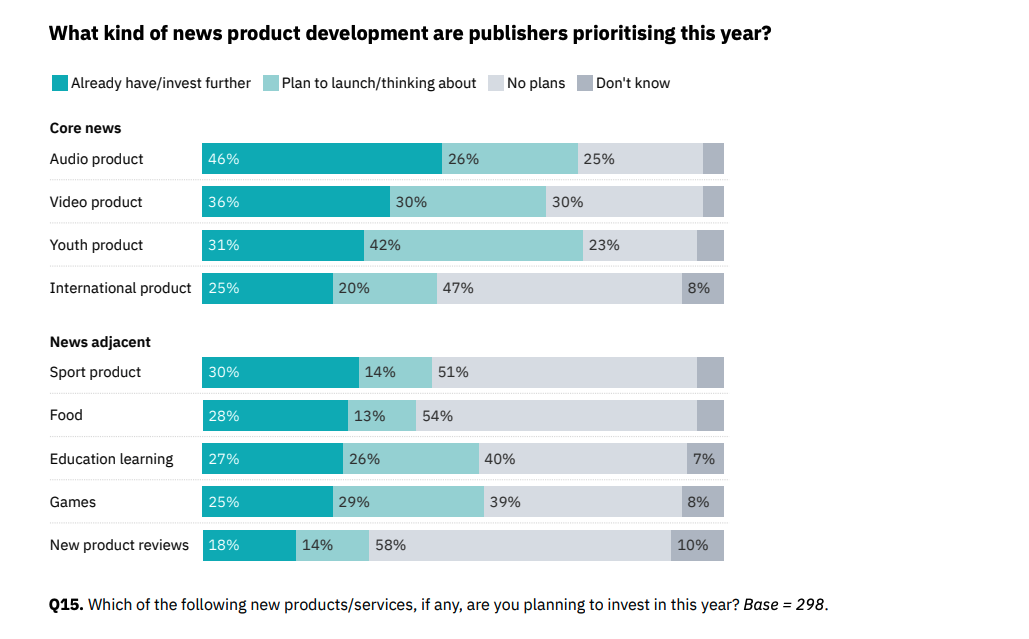
In Reuters's Trends and Predictions 2025, product innovation is widely recognized as a key driver of business growth.
The priority is on cultivating loyalty. Building relationships through newsletters, encouraging logins, and creating a clean reading experience that keeps people coming back.
Sarah Marshall, Condé Nast
Publishers are turning deep audience research into habit-building tools and are expanding into adjacent areas such as games, education, and food. Reading The New York Times' 2014 Innovation Report now, alongside headlines about them surpassing 11 million subscribers, it's clear why The Times is referenced in nearly every conversation about journalism's evolution. Their investment in innovation continues to pay off.
BuzzFeed and The New York Times are among the forerunners in introducing new engagement elements and products. Some of these (lists, quizzes, and crosswords) have become standard tools across the industry. What works and what feels out of place, however, depends heavily on brand identity, marketing, and the quality of execution. The best way to identify meaningful engagement features or products is to invest in innovation, listen to your audience and test continuously.
Engagement isn't just about hits or clicks. It's about whether we genuinely meet a user's need to be informed, challenged, or inspired, and whether that experience motivates them to return. For example, if a member feels that we consistently address their concerns or interests, they're more likely to come back regularly, open daily emails, and take part in comments or community events. That deeper level of participation is a key marker of engagement for us.
Sofie Flagstad Hansen, Zetland
Focusing on Audience Journey
Over the past decade, newsrooms have increasingly embraced funnel-based engagement strategies to create deeper relationships with their readers. This shift underscores the necessity of complementing quality journalism with strategic efforts such as content promotion, personalized experiences, and data-driven engagement efforts. However, the definition and points of view of audience engagement vary significantly across publishers, influenced by factors such as business models, organizational maturity, and data capabilities. For instance, a subscription-based outlet may prioritize metrics like repeat visits and time spent on site, while an advertising-driven platform might focus on page views and social shares.
Although there are different ways to describe the stages of the funnel, two principles tend to hold true. As users move deeper into the funnel, drop-off between stages increases significantly, while the value of each individual user continues to grow along the same trend.
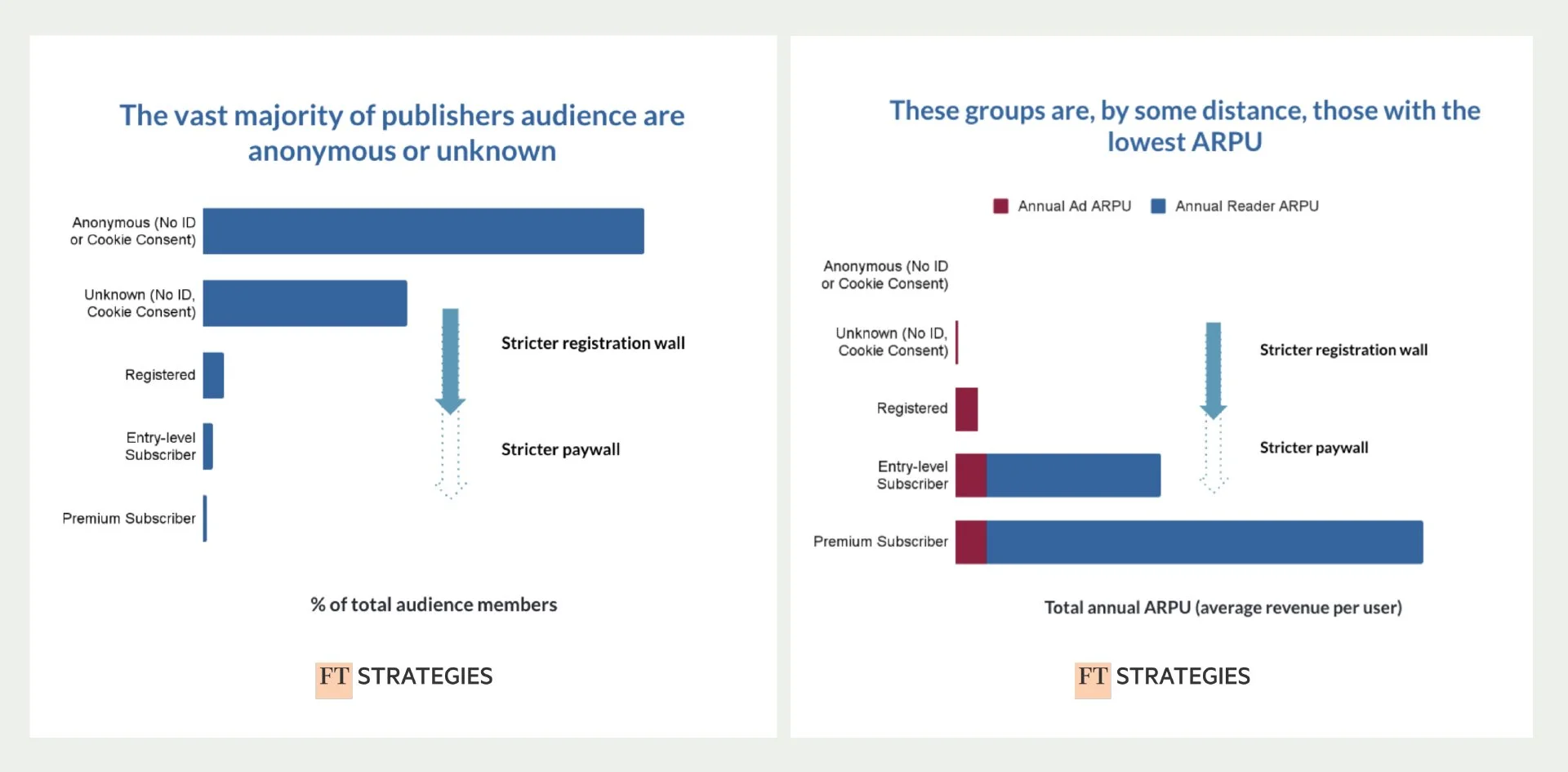
Visuals from FT Strategies highlight a core challenge for publishers: most audiences are anonymous or unknown, contributing minimal revenue. As users move deeper into the funnel their numbers drop sharply, but their value increases significantly. Image source: FT Strategies Trendlines & Headlines newsletter 04/25
Differing priorities reflect each organization's unique goals and resources. Incorporating funnel discipline into a newsroom requires a strategic shift toward audience-centered journalism. All staff should have the tools, and the shared vocabulary, to measure how well they are reaching, retaining, and engaging readers. To learn more about guiding audiences through the funnel from casual use to loyal advocacy go to Better News.
I sometimes still think in terms of a funnel, but I more often now think about 'chutes and ladders.' People might be highly engaged one month and two months later they drop down the chute and are not engaged, so I think about this constant movement up and down.
Alexandra Smith, The 19th
It's also worth noting a blind spot in the classic funnel view: subscriber is not the same as engaged user. A brand-new payer who converts through a paywall or promotion may still be far from genuine habit, even though the funnel slots them into the top tier. That gap is why many publishers, like The Atlantic, divide their growth work: one group hunts for paid acquisitions, while another half is tasked with onboarding, habit-building and retention. As Ross Maghielse of The Philadelphia Inquirer explains, his company keeps "two tiers" of audience development: marketing leads paid acquisition, whereas the newsroom programming team focuses on keeping readers active, because getting the credit card is only half the job.
We're going to start thinking less about purely driving the funnel process and more about maximizing the value of the audiences we have at the different stages they're at, and not being so reliant on a reader needing to complete the full funnel journey for them to be valuable to us.
Ross Maghielse, The Philadelphia Inquirer
The Philadelphia Inquirer's "post-funnel" approach treats audience growth as a set of parallel, valuable loops rather than a single, downward "awareness to conversion" funnel. A smart, dynamic paywall still optimises on-site subscriptions, but the newsroom's programming & audience desk also nurtures podcast listeners, Apple News readers, TikTok viewers, newsletter followers and other off-platform communities, each with its own engagement and revenue metrics. Because people constantly slide between these loops, paid-media specialists handle acquisition while the newsroom team focuses on habit-building and content formats that may never touch the paywall, judging success by the health of every loop instead of by a single funnel-conversion rate.
The critical thing in the future is figuring out how to keep all the burners going, even in a lightweight way. Then you can turn the dials up a bit when you see things taking off. Facebook audience has rebounded because they've made new decisions about their algorithms. We just shouldn't rely on it, ever.
Anna Dubenko, The New York Times
Sarah Marshall of Condé Nast contributed to the Nieman Lab Predictions for Journalism in 2025. Her prediction focused on the idea of "fattening the middle." Changes in platforms and user behavior at the top of the funnel are largely beyond publishers' control, but there is much that can be done in the middle to improve engagement and even drive monetisation. Marshall suggests focusing on the audience journey, creating clear pathways that guide unaware users toward becoming promoters and serving them as effectively as possible at each stage. That is where influence over your audience can be regained.
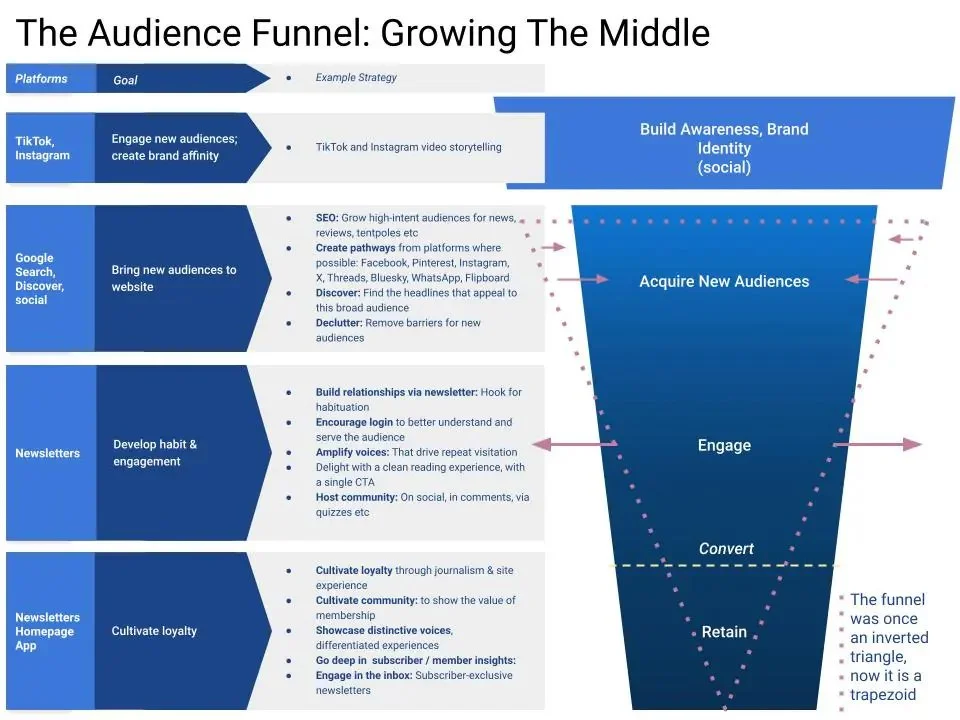
Condé Nast's audience funnel, with the middle fattened. Source: Focus on the "flabby middle" of the audience funnel, Sarah Marshall, Nieman Lab.
Change is constant, which is a reason to write the strategy down, not an excuse to skip it. Define the purpose of each product and platform, the target audiences, the key performance indicators, and where accountability sits. Strategic clarity lets teams recognise when a once-valuable channel has become a liability and stop funding it. Some declines cannot be reversed, and those resources do more good spent on meaningful engagement elsewhere. To create a platform strategy, see the Channel Strategy inspired by Condé Nast chapter in the Toolkit section.
The Future of Audience Engagement
When the industry accepted that the future could not be built on the platforms, it turned to what it owned. The article, the app, the newsletter and the homepage. Those are the things now being challenged, by AI and by how quickly readers have adapted to it. If the article is no longer the product, what is left to engage with?
Shuwei Fang, a fellow at Harvard Kennedy School's Shorenstein Center, argues that once machines become the primary audience, "the artefacts we have built around information (the article, the bulletin, the documentary) become structurally optional." Information can exist without a container at all. She calls this shift a move from artefacts to liquid information. What follows is a market that splits at two extremes, premium brands competing on distinctiveness and direct relationships at one end, commodity infrastructure at scale and thin margins at the other, with the middle hollowing out.
Predictions of the article's demise are not new. As early as 2011, Jeff Jarvis argued that the article was not the goal of journalism but a luxury, or a byproduct of the process. What Fang calls liquid information may finally end the article's run as the master artifact. But it was the arrival of AI, and the speed with which user behavior followed, that turned the question into a debate about the product itself. Two strategies for where to invest were presented on stage at the Nordic AI in Media Summit in 2026. In one, the publisher's relationship with the user grows stronger. In the other, the publisher ends up supplying raw material.
Gard Steiro, editor-in-chief of VG, and his team have built the first, though he frames it as a way to learn rather than as a product expected to win market share. VGX is a Norwegian news app with no article as we know it. Content is pulled from Schibsted titles, broken into journalistic atoms, and reassembled by AI agents acting as reporters and editors, with one human directing them through prompts. "The article as we know it is gone," Steiro said.
In his summit talk Steiro set out four scenarios for Schibsted and argued that only two are survivable, both of them ones where a publisher's own web and apps remain the primary entry point. Being a trusted brand inside someone else's AI service does not qualify. Publishers have "no future", he argued, if they let big tech assemble and control the media experience.
Ezra Eeman is looking outward from the same premise. If AI systems are becoming the interface through which people meet information, the journalism has to be legible to machines the publisher does not control. His argument is that the value is no longer the article but everything around it, provenance, context, editorial judgement and continuity over time. The work is turning that into something machine-readable.
They differ on the response. Steiro reassembles the components inside a product he owns, for readers he already has. Eeman is preparing them to be assembled by someone else, in an interface publishers never control. Nobody builds a habit around a single article. They engage with what a publisher offers them over time, and the two bets disagree about who gets to shape that. Which is right depends on a question nobody can currently answer: whether a direct relationship with readers is the one asset AI cannot take, or a luxury that delays the necessary work.
For publishers who already have that relationship, the stakes are sharper. Nordic newsrooms have spent a decade building exactly what Steiro is testing against, an audience that arrives without being sent.
It is worth asking why that was possible. The platforms that reshaped discovery, search and social, arrived in Finland as everywhere else. What never arrived was the kind of product that needs staff who speak the language. Apple News runs on about a hundred human editors, and that dependence is what has held back its expansion beyond a handful of English-speaking markets. Small markets have been protected by loyalty, but also by the cost of employing people to serve them.
That is the protection AI removes. The technology is already running in customer-facing products at both ends of the market. In the United States, Particle has been building an AI news reader since 2024 with licensing deals and links back to publishers, while in Finland Freepress launched in September 2025 with AI-generated summaries aggregated from news sites. This kind of use has drawn criticism over copyrighted content. Whether either finds an audience and a business model that works for itself and for publishers is still open. Instead of being a prediction, liquid information is in its discovery phase.
Without engagement we have nothing. Since the digitalization of media, editorial teams have had to steer toward a new reality after every era shift. What we doubled down on in one era may have lost its magic in the next, and each shift brings serious unlearning. The categories that flourished a while ago may have lost their pull, because not all journalism is treated equally by changing behavior and by AI. Analysis of UK newsbrands in early 2026 found health sections losing the link to an AI summary 72% of the time, against 15% for sport and 7% for puzzles. Queries that turn on settled knowledge suit a summary. Queries that need new information do not. This is a serious moment for publishers with deep roots in a beat.
Put it to work
To build a platform strategy, see Channel Strategy inspired by Condé Nast. To test whether a feature or product actually improves engagement, see The Atlantic's Reader State model.
Footnotes
-
Philip Schlesinger, Putting 'Reality' Together: BBC News (London: Constable, 1978). ↩
-
Emily Bell and Taylor Owen, The Platform Press: How Silicon Valley Reengineered Journalism (New York: Tow Center for Digital Journalism, Columbia Journalism School, 2017). ↩ ↩2
-
Julie Posetti, Time to Step Away from the 'Bright, Shiny Things'? Towards a Sustainable Model of Journalism Innovation in an Era of Perpetual Change (Oxford: Reuters Institute for the Study of Journalism, November 2018). ↩
-
Nic Newman, Journalism, Media, and Technology Trends and Predictions 2019 (Oxford: Reuters Institute for the Study of Journalism, 2019). ↩
-
Nic Newman, Journalism, Media, and Technology Trends and Predictions 2026 (Oxford: Reuters Institute for the Study of Journalism, 2026). ↩ ↩2
-
Digital News Report 2026 (Oxford: Reuters Institute for the Study of Journalism, 2026). ↩
-
Rasmus Kleis Nielsen and Sarah Anne Ganter, The Power of Platforms: Shaping Media and Society (New York: Oxford University Press, 2022). ↩